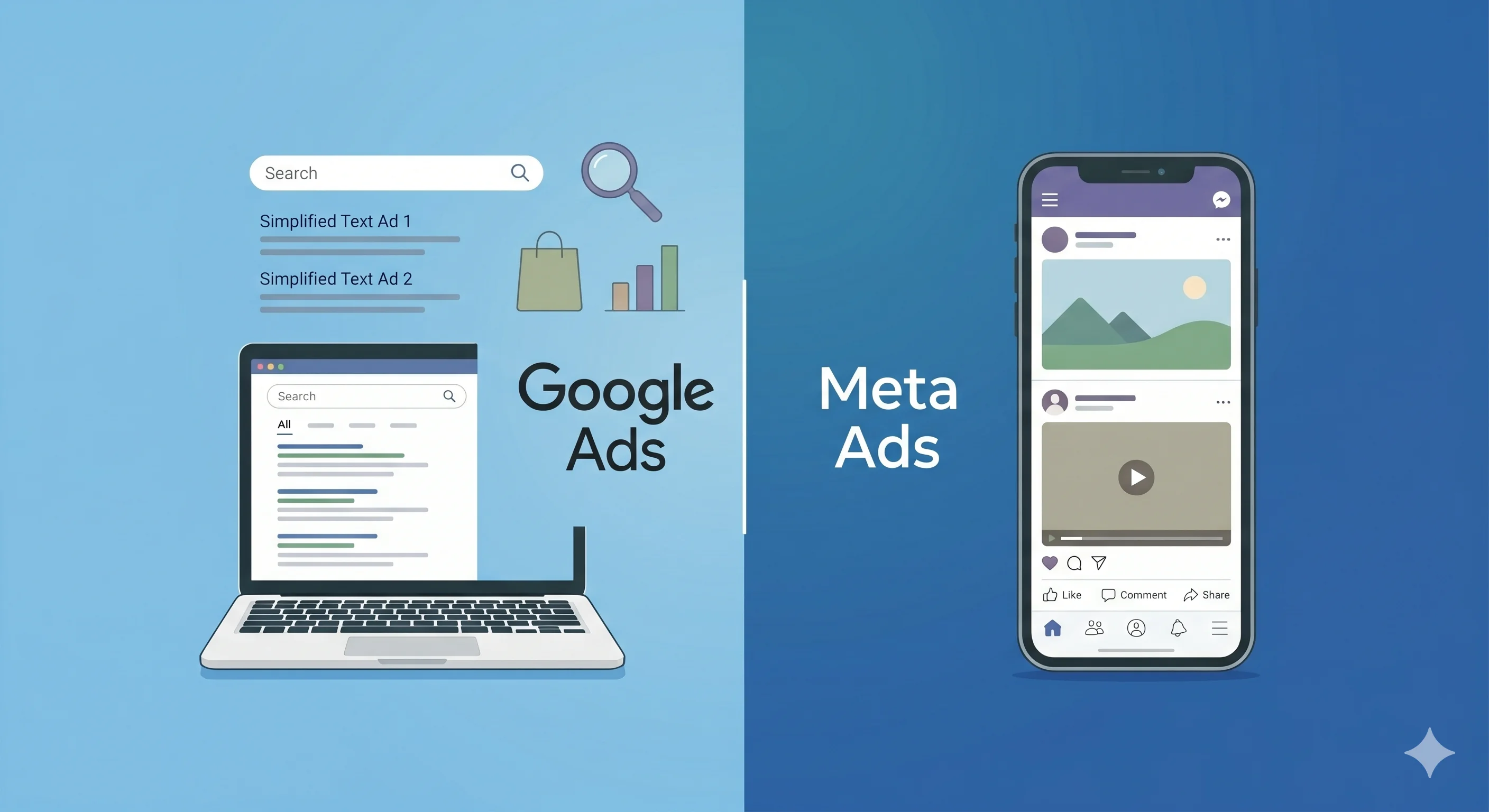
In the modern digital marketing landscape, the question is never "which platform is better overall?" but rather "which platform delivers the highest technical efficiency and Return on Ad Spend (ROAS) for your specific business model?". At Weblix, we tackle this question daily with developers and business owners looking to optimize their paid traffic acquisition channels and integrate them seamlessly with their core web architecture.
Choosing between the Google Ads ecosystem and Meta Ads ecosystem (Facebook and Instagram) requires a profound understanding of user intent, technical tracking configurations, and conversion funnel structures. This article provides a comprehensive, highly technical analysis to help you make the right strategic decision.
1. Intent-Based Traffic vs. Discovery-Based Marketing
The primary technical differentiator between the two networks lies in the user's mental state—commonly referred to as "User Intent." This distinction completely alters how campaigns are structured and how conversion rates fluctuate.
Google Ads: Capturing High Purchase Intent
Google Search Ads operate strictly on keywords. When a user types a search query like "buy fast wordpress hosting" or "app development company in Dubai," they are actively expressing a clear, immediate intention to solve a problem or make a purchase at that exact millisecond.
- Conversion Rate (CR): Typically very high because you are presenting a direct solution to an active searcher.
- Funnel Position: Targets high-value traffic at the Bottom of the Funnel (BOFU).
Meta Ads: Interruption and Discovery Marketing
Conversely, users do not scroll through Facebook or Instagram with an immediate credit card in hand. Instead, they seek social connection, content consumption, and entertainment. Meta Ads work by "interrupting" this user experience based on deep demographic data, behavioral patterns, and granular interest profiles.
- Core Mechanism: The ad targets the user's digital footprint rather than active search terms.
- Funnel Position: Primarily Top or Middle of the Funnel (TOFU/MOFU), introducing the brand to users via high-impact visuals or engaging video creatives.
2. Technical Tracking Infrastructure and Data Pipelines
From a purely technical SEO and engineering perspective, ad performance heavily relies on the quality of conversion signals fed back into the machine learning algorithms. Post-iOS 14+ privacy rollouts and the deprecation of third-party cookies have fundamentally altered how these data pipelines function.
Google Ads Tracking Architecture
Google utilizes an integrated environment linking Google Analytics 4 (GA4) and the native Google Ads Conversion Tracking script.
- Enhanced Conversions: This feature allows your website to securely send hashed user data (like SHA256-encrypted email addresses) back to Google. It stabilizes conversion measurement even when standard browser cookies fail to fire.
- Google Tag Manager (GTM) Orchestration: GTM enables granular event tracking (micro-conversions) such as specific button clicks, form interactions, or deep scroll depth on high-performance landing pages.
Meta Ads Tracking Architecture
Meta bypassed strict browser privacy frameworks by creating a hybrid tracking ecosystem combining client-side and server-side data extraction:
- The Meta Pixel: The traditional browser-based script executing events like ViewContent, AddToCart, and Purchase.
- Meta Conversions API (CAPI): This is the gold standard for modern Meta tracking. CAPI streams events directly from your website's origin server to Meta's servers. By bypassing ad blockers and browser restrictions, CAPI guarantees server-to-server data integrity, keeping the ad delivery optimization algorithm highly stable.
Technical Insight from Weblix: We strongly recommend implementing Server-Side Tracking via GTM. Deploying data streams to both Google and Meta simultaneously minimizes data loss and significantly lowers Cost Per Acquisition (CPA).
3. Campaign Archetypes and Visual Formats
Both platforms provide specialized campaign architectures configured around unique business metrics.
Google's Automation and Search Layouts
- Search Campaigns: Text-driven ads deployed directly inside Google SERPs (Search Engine Results Pages).
- Google Shopping: Crucial for e-commerce platforms, pulling product inventory data directly into search results complete with pricing and images.
- Performance Max (PMax): An AI-driven campaign type that unifies assets across all Google properties—including YouTube, Search, Display, Maps, and Gmail—using a single cross-channel automated budget.
Meta's Visual Richness and Social Commerce
Meta excels at high-conversion visual real estate:
- Reels and Video Ads: The current industry standard for generating high engagement metrics and capture rates.
- Carousel Ads: Ideal for showcasing structured product lineups or telling sequential brand narratives.
- Advantage+ Shopping Campaigns: Meta's completely automated machine learning system that optimizes targeting, placement, and creative rotation to drive scaled volume for digital storefronts.
4. Financial Metrics: Cost Structures and Return Models
Let's break down the comparative data across critical campaign management Key Performance Indicators (KPIs):
| Technical/Financial Metric | Google Ads Ecosystem | Meta Ads Ecosystem |
|---|---|---|
| Primary Bidding Model | Cost Per Click (CPC) | Cost Per Mille / Thousand Impressions (CPM) |
| Relative Cost Thresholds | Generally higher CPC due to direct keyword competition | Lower cost for raw reach, though high-intent actions scale up |
| Velocity of Initial Success | Immediate feedback loop if targeting high-intent keywords | Requires structured sandbox testing phases for creatives |
| Creative Maintenance Assets | Low to moderate (Focus relies on text copy and landing page UX) | Extremely high (Older creatives suffer from Ad Fatigue quickly) |
| Geographic/Local Precision | Unmatched accuracy for local services and maps search | Excellent for demographic profiling and lookalike expansion |
5. Strategic Blueprint: Google Ads vs. Meta Ads
Based on empirical performance matrices and our development experience at Weblix, here is how you should partition your paid media capital:
Allocate Budget to Google Ads If:
- Your business model is built on urgent/on-demand services: Examples include emergency plumbing, legal defense, urgent care clinics, or breakdown towing. Users in these critical situations do not browse social feeds waiting for an ad; they search for immediate resolutions.
- You sell established, high-search-volume brands: Where consumer search behavior is locked directly onto specific product names, SKU variations, or distinct model codes.
- Your immediate objective is raw conversion velocity: And you need to validate product-market fit using high-intent keywords while cutting out zero-intent traffic waste.
Allocate Budget to Meta Ads If:
- Your product thrives on visual aesthetics: Industries like fashion, culinary brands, prime real estate, modern interior design, or lifestyle items that rely on fast-paced video explainers to showcase emotional value.
- You are pioneering a brand-new niche (Demand Generation): If your product solves a completely unique problem that consumers aren't searching for yet on Google, Meta allows you to manufacture demand by introducing the solution directly to target demographics.
- The goal centers on Community Building and Brand Identity: Leveraging deep post-interaction comments, social shares, and direct message marketing.
Conclusion: The Hybrid Architecture Wins the Market
The highest growth curves are never unlocked by abandoning one platform for another. True enterprise scalability happens when you construct a unified, hybrid marketing funnel where Google and Meta work in technical alignment.
The Elite Conversion Setup: Deploy highly tailored Meta Ads to capture attention, cultivate product awareness, and drive initial targeted traffic to your domain (TOFU). Simultaneously, configure hyper-focused remarketing pipelines via Google Ads and Search Networks to convert those same prospects the moment they actively search for your brand reviews, product specs, or final price comparisons.
Remember, no matter which ad network you fund, your overall conversion rate remains bottlenecked by the code quality of your landing pages and your optimization metrics (Core Web Vitals). Building that bulletproof, high-speed digital infrastructure is precisely what we excel at here at Weblix.