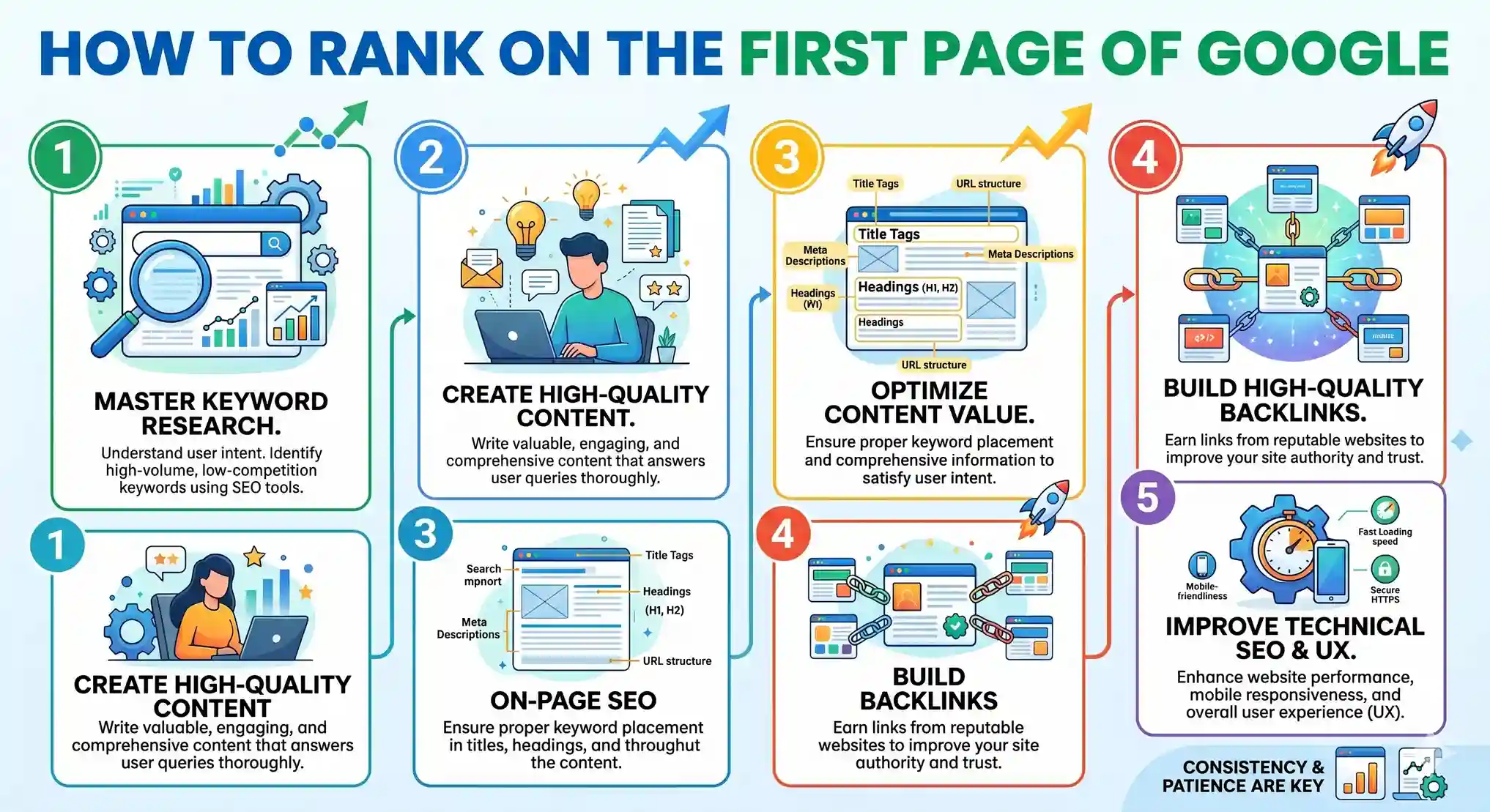
Introduction: The Reality of the First Page
There is a long-standing joke in the digital marketing realm: "The best place to hide a dead body is the second page of Google search results." While amusing, it highlights a stark reality for businesses, developers, and marketers. Statistics consistently show that over 90% of all organic clicks are captured by the first page, leaving millions of websites fighting for the remaining fraction of a percent.
At Weblix, we frequently consult with clients who are frustrated by their inability to break through the algorithmic ceiling, despite having exceptional products or well-crafted content. The root cause is rarely the business offering itself; rather, it's a communication breakdown between the website's technical architecture and Google's crawling bots. Google is an incredibly sophisticated engine that looks far beyond mere keyword placement. It evaluates server response times, indexing efficiency, user experience, and structural authority.
In this comprehensive guide, we will bypass the generic advice like "put your keyword in the title." Instead, we will dive deep into the advanced Technical SEO and content strategies that we employ at Weblix to propel our clients out of obscurity and into the top-ranking positions.
1. Technical SEO Foundation: The Bedrock of Ranking
Before you write a single piece of content or build a backlink, your digital infrastructure must be flawless. Technical SEO ensures that search engines can actually access, render, and understand your website.
Crawl Budget Optimization and Indexability
Google does not have infinite resources to crawl your website indefinitely. It assigns a "crawl budget" based on your domain's authority, server capacity, and overall size. If your website is bloated with low-quality URLs, infinite redirect chains, or parameter-heavy dynamically generated pages (like complex eCommerce filters), you are burning through your crawl budget.
- The Weblix Approach: We always start technical audits with deep Log File Analysis to observe exactly how Googlebot interacts with the server. We meticulously optimize the
robots.txtfile to block non-essential pathways, implement precise Canonical tags to consolidate duplicate content signals, and ensure XML sitemaps are pristine and free of 4xx or 5xx errors.
Core Web Vitals and Performance Metrics
Page speed is no longer just a user preference; it is a strict ranking factor. Google evaluates real-world user experience metrics known as Core Web Vitals:
- LCP (Largest Contentful Paint): Measures how long it takes for the largest element (usually a hero image or text block) to render. The gold standard is under 2.5 seconds. We achieve this by establishing critical rendering paths, deferring non-essential CSS, preloading key assets, and deploying next-gen image formats like WebP or AVIF through edge-caching CDNs.
- INP (Interaction to Next Paint): The metric that recently replaced FID, measuring the visual latency of user interactions. To optimize INP, we ruthlessly audit JavaScript payloads, implement web workers to offload main-thread execution, and break up long tasks.
- CLS (Cumulative Layout Shift): Measures visual stability. We eradicate layout shifts by strictly reserving space for dynamic elements, ads, and images using exact CSS aspect ratios before they load.
JavaScript SEO and the Rendering Challenge
Modern web development relies heavily on frameworks like React, Vue, and Angular. While fantastic for user experience, Client-Side Rendering (CSR) can be an SEO nightmare because search bots initially see a blank HTML document with a script tag. Relying on Google's two-pass indexing for JavaScript can delay your rankings for weeks.
At Weblix, we champion Server-Side Rendering (SSR) or Static Site Generation (SSG) using frameworks like Next.js and Nuxt.js. This architecture guarantees that the HTML is fully hydrated and delivered to Googlebot instantaneously, eliminating the "render budget" bottleneck entirely.
2. Entity-Based Content and Search Intent
The era of keyword stuffing is long dead. Google's algorithm is now heavily driven by natural language processing and semantic understanding. It maps queries to "Entities" (people, places, concepts) rather than just stringing words together.
Mastering Search Intent
Selecting high-volume keywords is useless if you don't align with the user's Search Intent. If a user queries "best CRM for startups," their intent is informational/comparative. If you try to rank a direct landing page selling your CRM software for that term, Google will actively suppress it. The engine knows the user wants to read a comparative review, not a hard sales pitch.
You must map your page types—whether it's a deep-dive blog post, a product category, or a utility tool—precisely to the intent behind the query.
The Topic Cluster Architecture
To establish topical authority, you must structure your content intelligently. We use the Pillar/Cluster model:
- Pillar Pages: Comprehensive, long-form guides covering a broad topic (e.g., "The Ultimate Guide to Cloud Hosting").
- Cluster Pages: Highly specific, targeted articles addressing niche subtopics (e.g., "How to migrate from AWS to Google Cloud", "Understanding Cloud Server Security").
- Strategic Internal Linking: Every cluster page links back to the pillar, and the pillar links to the clusters. This creates a dense, semantic web of internal links that passes PageRank efficiently and signals to Google that you hold complete topical dominance in this niche.
3. E-E-A-T: Experience, Expertise, Authoritativeness, Trustworthiness
Following recent Core Updates, Google’s Quality Rater Guidelines heavily emphasize E-E-A-T. This is exceptionally critical for YMYL (Your Money or Your Life) websites, such as financial, legal, or medical platforms.
Proving Expertise to Algorithms
You cannot rank on the first page as a faceless entity.
- Author Transparency: Create detailed author bio pages showcasing the writer's credentials, real-world experience, and links to professional profiles like LinkedIn.
- Content Pruning and Decay: Outdated or factually incorrect content destroys your site’s trustworthiness. At Weblix, we perform regular content pruning for our clients. We identify pages losing traffic and either rewrite them with fresh data, consolidate them into stronger pages via 301 redirects, or delete them if they represent technical debt.
Digital PR and High-Tier Link Building
Forget buying cheap backlinks from link farms; Google's spam algorithms (like SpamBrain) will neutralize or penalize those links. Authority is earned, not bought.
We execute Digital PR campaigns. By creating proprietary research, original data studies, or interactive tools, we give high-tier publications (like Forbes, TechCrunch, or industry-specific journals) a compelling reason to link to our clients natively. A single contextual link from an authoritative domain outweighs thousands of low-quality directory submissions.
4. Continuous Analytics and Iteration
SEO is not a one-time project; it is a continuous loop of hypothesis, execution, analysis, and refinement.
Leveraging Google Search Console (GSC)
GSC is the most accurate source of truth for SEO. We dive deep into its data to uncover hidden opportunities:
- CTR (Click-Through Rate) Optimization: If a page ranks on the bottom of page one but gets no traffic, the issue is often the Title Tag or Meta Description. We run A/B tests on SERP snippets to make them more enticing, using psychological triggers and clear value propositions to steal clicks from higher-ranking competitors.
- Identifying Cannibalization: We ensure that multiple pages on your site aren't competing for the exact same keyword, which confuses Google and dilutes your ranking power.
Mobile-First Indexing Perfection
Google strictly uses the mobile version of your site for indexing and ranking. If your desktop site is stunning but your mobile site hides content, loads slowly, or features unclickable tap targets, your rankings will tank. Ensure absolute parity between mobile and desktop content, optimize viewport scaling, and eliminate intrusive interstitials.
Conclusion: Partnering for First-Page Success
Ranking on the first page of Google is not a matter of luck. It is the direct result of superior technical engineering, strategically structured content, and relentless optimization that outpaces your competition. It requires deep expertise and an understanding of how search algorithms evolve on a micro-level.
If you are looking for a technical partner who understands web development and SEO from the server level up to the user interface, the Weblix team is ready to transform your digital presence. We don't just build websites; we build high-performance engines designed to capture traffic, generate leads, and dominate search results. Reach out to us today for a comprehensive technical SEO audit.