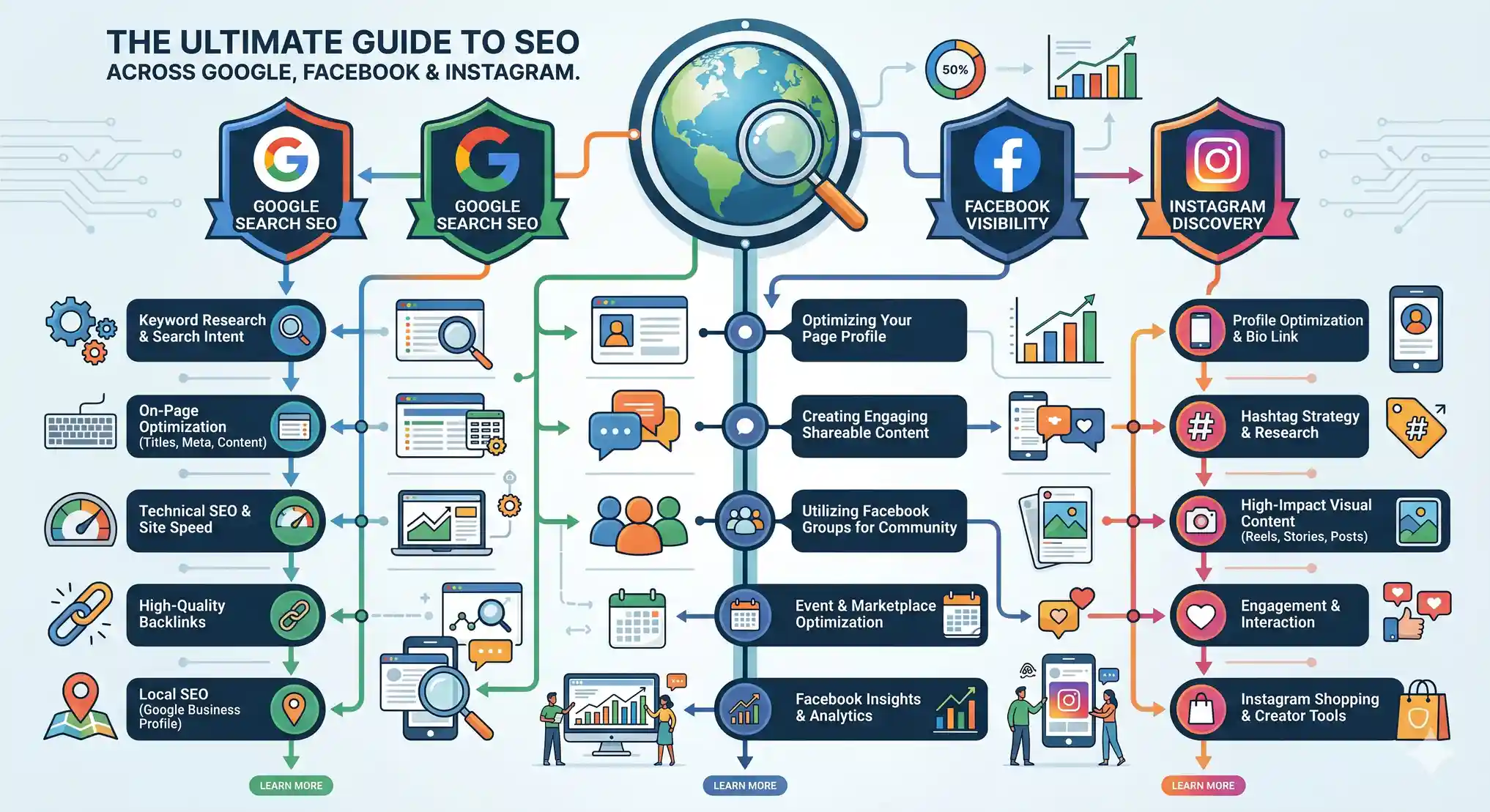
The digital search landscape has undergone a radical transformation. No longer is SEO limited to stuffing keywords into website pages to rank exclusively on traditional Google Search result pages. Today, social platforms like Facebook and Instagram have evolved into fully functioning search engines relied upon by millions daily to discover products, services, and mobile applications.
If you own a smart app, a digital platform, or a website, relying solely on legacy SEO methodologies means abandoning more than half of your potential market share. At Weblix, we firmly believe that a successful growth strategy requires complete technical and organic integration across all these digital environments to build a unified funnel that guides users straight to your platform. In this deeply technical architectural guide, we will break down exactly how to engineer a content and software infrastructure that guarantees top rankings on Google, Facebook, and Instagram simultaneously.
1. Technical SEO for Google and App Indexing
The objective here is not just driving traffic to a landing page, but programmatically linking your website with your native mobile application (whether Android or iOS). This ensures Google's search algorithms understand that the mobile app is a direct extension of the web domain, enabling app content to surface natively within standard search engine result pages (SERPs).
A. Deep Linking and Omnipresent App Links
Deep linking forms the structural backbone of application-focused technical SEO. Without it, search spiders view your application as a "black box" with inaccessible contents.
- Android App Links: These allow specified web URLs to immediately trigger and open the native application without prompting the user with a confusing selection dialog. This setup requires generating a highly structured technical configuration file named
assetlinks.jsonand hosting it under a precise, secure path on your domain:https://yourdomain.com/.well-known/assetlinks.json. This file strictly declares the package name of the app and its encrypted SHA256 fingerprints. - Apple Universal Links: This technology performs the exact equivalent functionality for iOS ecosystems. It requires deploying a specialized JSON file named
apple-app-site-association(strictly without a.jsonextension) within the same.well-knownsecure root directory mentioned above.
When Googlebot crawls your web properties and verifies that these deployed configuration files match the corresponding application metadata uploaded to the Google Play Store and Apple App Store, it begins indexing app "screens" relative to your web URLs. This synchronization signals exceptional architectural authority, boosting your search positioning.
B. Structured Data for Entity Graph Association
While we avoid hardcoding raw scripts here, it is paramount to engineer your content architecture to explicitly leverage digital Entity Graphs. Your web layout must present clean schema associations linking the main domain, the Google Play download URL, the iOS App Store URL, and your official Facebook and Instagram profiles. This clear relational mapping provides Google with unambiguous proof that your website, application, and social touchpoints belong to a single consolidated business entity, radically reinforcing your algorithmic trust and Topical Authority (E-E-A-T).
2. Instagram SEO: Cracking the Visual Search Algorithm
Instagram has decisively pivoted from a simple photo-sharing feed into a robust visual search engine powered by neural semantic analysis and user interaction mapping. Relying on generic, saturated hashtags is an obsolete practice; your commercial profile must be optimized technically so that platform AI reads your content as an exact answer to user intent.
A. Core Profile Architecture Optimization
Your profile page operates as the structural "homepage" of your Instagram search real estate. The internal ranking algorithms begin calculations right here:
- The Name and Username Fields: You must weave your primary technical keyword directly alongside your core brand name. For example, instead of merely writing "Weblix", we structurally execute it as "Weblix | Web Development & SEO". This guarantees that your business account surfaces instantly when a prospect inputs "Web Development" into the search bar.
- The Bio Paragraph: This text must be engineered with absolute clarity, identifying your core niche while embedding high-volume, contextual LSI (Latent Semantic Indexing) keywords, accompanied by a clean, tracked call-to-action link pointing directly toward your app download or main web terminal.
B. Manual Alt Text and Computer Vision Alignment
The modern Instagram algorithm deploys advanced computer vision models to parse image files. When you publish a product mockup or an application interface screenshot, the AI scans the pixels to classify the visual elements.
- Manual Alternative Text Injection: Never delegate alternative text generation to automated platform AI. Navigate directly to the advanced settings of every single post and compose keyword-rich, highly descriptive alt text that outlines the image. This precise step does not merely assist internal Instagram discovery; it positions your social assets to rank directly within traditional Google Images results.
C. Semantic Textual Optimization Within Captions and Reels
Captions are no longer mere resting places for emojis. Contemporary search engines within Instagram perform comprehensive semantic analysis across the entirety of your text block to determine contextual relevance. Write comprehensive, high-value captions detailing real technical issues and solutions. Ensure your high-priority transactional keywords populate the initial two lines of text, as these carry the heaviest mathematical weight during index valuation.
3. Facebook SEO: Structuring Social Graph Data
Facebook operates a highly complex internal database directory known as Graph Search. Optimizing for this framework requires managing your commercial Facebook Business Page with the same analytical precision applied to a standalone web property.
A. Open Graph Protocol Engineering
This implementation occurs completely on the backend of your web platform or application architecture. When a user shares a direct hyperlink to your app or deep content page on Facebook, the platform parses your metadata to render a structured preview block containing a high-resolution image, an optimized title, and a compelling snippet. Ensuring your Open Graph tags (specifically og:title, og:description, and og:image) are dynamically generated and clean dramatically maximizes your CTR (Click-Through Rate). Facebook interprets this heightened engagement as a positive structural signal, expanding your organic reach algorithmically.
B. Business Page Schema Optimization
Countless organizations neglect structural page completeness, dropping their profiles to the absolute bottom of search indices.
- Vanity URL Standardization: Your social handle must remain compact, direct, and completely identical to your core corporate naming convention (e.g.,
facebook.com/weblix). - The "About" and Story Segments: These fields serve as your primary textual keyword goldmines. You must compose highly descriptive overviews of your services, software architectures, and applications, seamlessly integrating direct download anchors and technical support channels.
- Geographical and Location Synchronization: If your software platform serves localized markets, your Local SEO on Facebook demands that your physical coordinates are mapped perfectly to align with nearby user search queries.
4. The Unified Cross-Platform Framework by Weblix
True digital dominance is achieved when these independent channels run as synchronized gears within a singular marketing engine. Here is the strategic framework we deploy at Weblix to unite all three ecosystems:
A. Omnichannel User Flow Architecture
We map out an ironclad traversal funnel: organic posts published across Facebook and Instagram carry specialized deep links that immediately launch the required content screen inside the mobile app if installed. If the user accesses the link via a standard browser, they are seamlessly routed to a lightning-fast web landing page fully optimized for Google SEO. This landing page features structural data pointing right back to the social channels and mobile store entries. This self-reinforcing layout creates a perpetual discovery loop where search rankings across Google and social platforms feed into one another.
B. Keyword Uniformity Across Digital Entities
When conducting your initial keyword research phases, never look at Google data in isolation. Utilize modern cross-channel metrics to identify terms real users search for directly within social systems (which frequently skew more conversational and transactional). Produce a highly detailed pillar content piece for your web domain, then deliberately slice it into targeted short-form video scripts for Instagram Reels and discussion posts for Facebook—maintaining rigid keyword synchronization across every channel.
Weblix Expert Insight: Maintaining absolute consistency across your textual keywords, brand descriptions, and application metadata across Google, Facebook, and Instagram forms a highly recognizable "Digital Entity Footprint" within modern AI models. This cross-channel alignment trains neural networks to serve your brand as the definitive answer, regardless of where the end consumer initiates their search journey.
Always keep in mind that Search Engine Optimization is never a static, one-time configuration; it is a continuous software and content engineering process that demands diligent performance data monitoring, rapid crawl error resolution, and constant keyword iterations. At Weblix, we construct these robust technological foundations so your digital assets and mobile applications maintain absolute market leadership.